
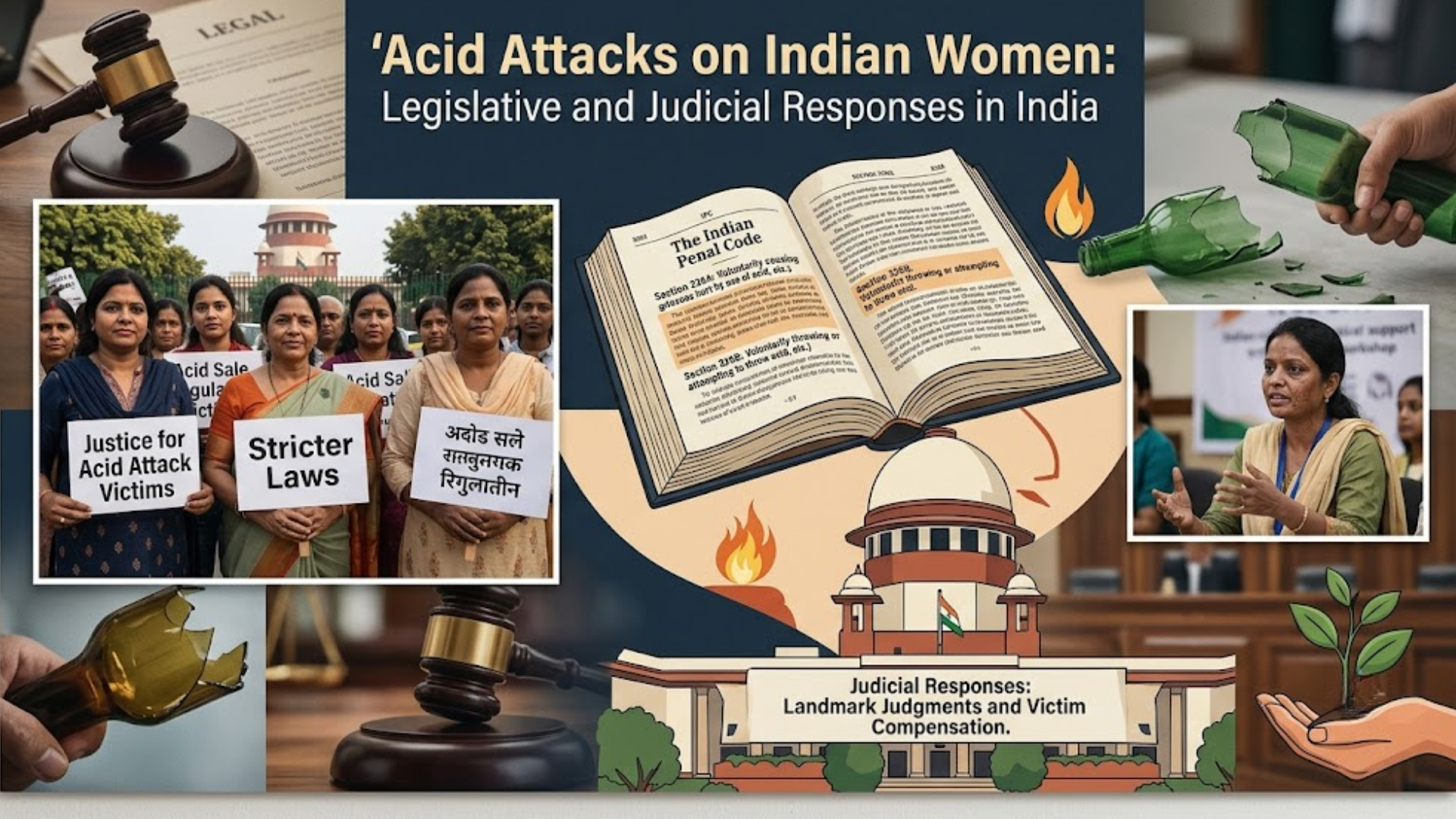
Acid attacks are one of the most heinous forms of violence, inflicting both physical and psychological trauma on the victims. In India, acid attacks have become a significant concern, particularly due to the growing incidence of such crimes against women. Acid attacks involve the deliberate throwing of corrosive substances, typically acid, on a victim’s face, body, or other parts, often leading to severe disfigurement, disability, and lasting emotional trauma. These attacks are commonly motivated by revenge, rejection, or perceived dishonor and frequently occur in situations of domestic disputes, unrequited love, or societal pressures.
Despite the growing recognition of acid attacks as a grave form of violence, India has seen widespread criticism for its inadequate legislative and judicial responses to the issue. The country has made progress in terms of legal reforms and judicial interventions, but challenges remain in the effective enforcement of these measures. This article will delve into the legislative and judicial responses to acid attacks on women in India, exploring the evolution of laws, judicial attitudes, and the challenges in implementation, while also proposing suggestions for a more robust and victim-centric approach to tackling this social evil.
Understanding the Scope and Impact of Acid Attacks
Acid attacks are deeply traumatic and devastating acts of violence, typically involving the use of sulfuric or hydrochloric acid. The corrosive nature of these substances can cause extensive damage to the skin, muscles, bones, and eyes, often leading to permanent disability and disfigurement. Acid attacks are not just physical crimes; they also carry significant psychological consequences. Victims often experience immense emotional distress, social stigma, and psychological disorders such as depression, anxiety, and post-traumatic stress disorder (PTSD).
Women are disproportionately affected by acid attacks in India. According to statistics, more than 1,000 acid attacks are reported annually in the country, with the majority of victims being women. These attacks are often committed by men who feel rejected, aggrieved, or dishonored. In many cases, acid attacks are used as a tool of retaliation for rejection of marriage proposals or romantic advances, as well as for reasons of jealousy, perceived insult, or familial disputes. This form of violence is seen as an extreme way to assert control over women’s bodies, autonomy, and social agency.
Legislative Responses: Evolution of Laws on Acid Attacks
Acid attacks were initially treated as ordinary criminal offenses under Indian law. However, due to the specific nature and severity of these crimes, the Indian legislature began to acknowledge the need for more targeted laws to address acid attacks in particular.
- Section 326A and 326B of the Indian Penal Code (IPC) (2013)
Before 2013, acid attacks were classified under general provisions of the Indian Penal Code, such as Section 320 (grievous hurt) and Section 307 (attempt to murder). However, this did not adequately address the unique aspects of acid attacks, such as the nature of the injury and the long-term physical, psychological, and social consequences for victims.
In 2013, the Indian Parliament amended the IPC to include specific provisions dealing with acid attacks. These amendments, introduced by the Criminal Law (Amendment) Act, 2013, added Section 326A and Section 326B to the Indian Penal Code, specifically dealing with acid attacks.
- Section 326A defines the punishment for voluntarily throwing or attempting to throw acid, which may cause severe harm to the victim’s body. The punishment for this offense is imprisonment for a minimum term of 10 years, extending to life imprisonment, and a fine. The law recognizes the severe nature of acid attacks, with the provision for lifetime imprisonment reflecting the gravity of the crime.
- Section 326B deals with the act of throwing or attempting to throw acid with the intent to harm or disfigure another person but without causing the injury defined in Section 326A. The punishment under this section may extend to 5 years of imprisonment and a fine.
These legal provisions marked a significant shift in the legal landscape by explicitly addressing acid attacks as a distinct crime, with specific punishments that reflect the severity of the offense.
- The Protection of Women from Acid Attacks: The 2013 Law on Sale of Acid
One of the primary challenges in curbing acid attacks is the unrestricted availability of acids and corrosive substances in markets. Acid is often sold in general stores or open markets without regulation, making it easily accessible to perpetrators of these crimes. In 2013, the Indian government took a significant step by regulating the sale of acid under the Chemical Weapons Convention Act (2013).
Under this legislation, the sale of acid is strictly regulated, and vendors are required to maintain a record of buyers, including the buyer’s name, address, and purpose of purchase. Acid can now only be sold to individuals who are able to present valid identification and show that they require the substance for legitimate purposes, such as industrial use. This measure aims to reduce the availability of acid to potential offenders, although challenges in enforcement persist.
- The Compensation Scheme for Acid Attack Victims (2015)
In 2015, the Indian government introduced the Acid Attack Victims’ Compensation Scheme, which was aimed at providing financial assistance to the victims of acid attacks for medical treatment, rehabilitation, and legal aid. Under the scheme, the central government, along with state governments, has been tasked with compensating victims for the damages they have incurred. The compensation amount varies depending on the severity of the injuries and the degree of harm caused to the victim.
The scheme provides much-needed financial support to victims, many of whom face prolonged medical treatments and rehabilitation. However, while the scheme is a step in the right direction, many victims have reported delays in receiving compensation, indicating the need for more efficient implementation of this provision.
Judicial Responses to Acid Attacks
Judicial responses to acid attacks in India have played a crucial role in ensuring that victims receive justice and that perpetrators are held accountable for their actions. Several landmark judgments by the Indian judiciary have shaped the legal approach to acid attacks.
- Laxmi v. Union of India (2014)
One of the most notable judicial interventions came in the form of the Laxmi v. Union of India case. Laxmi, a young woman, became a victim of an acid attack by a rejected suitor in 2005. Her case became a landmark in the struggle for justice for acid attack survivors.
In 2014, the Supreme Court of India issued a landmark ruling in this case, recognizing the need for stricter regulation of acid sales and imposing a duty on the government to ensure that acid attacks are treated as a separate category of crime. The Court emphasized the severity of acid attacks and ordered the creation of a nationwide policy to regulate the sale and distribution of acid. The Court also ordered the establishment of a compensation fund for acid attack victims and directed the government to set up proper rehabilitation facilities for them.
Furthermore, the Supreme Court laid down certain guidelines for the treatment of acid attack cases, including the immediate registration of complaints and the provision of medical care to victims. This judgment marked a turning point in the legal response to acid attacks in India, setting out specific legal and procedural steps to address the issue.
- Guidelines for Victims’ Protection and Compensation (2015)
In 2015, the Supreme Court issued additional guidelines related to the treatment and protection of acid attack victims. These guidelines require that the police take swift action in cases of acid attacks and that victims receive immediate medical attention, including free treatment in government hospitals.
The Court also mandated the establishment of special courts to handle acid attack cases, ensuring that these cases are heard and decided in a timely manner. Furthermore, the Court directed that acid attack victims be given financial compensation to cover their medical expenses and rehabilitation costs. These guidelines were aimed at providing a holistic and victim-centered approach to the issue of acid attacks.
Challenges in the Enforcement of Laws
Despite the existence of legal frameworks and judicial directives, there are several challenges in the effective implementation of laws against acid attacks in India.
- Weak Enforcement of Regulations on Acid Sales
One of the main challenges in preventing acid attacks is the ease with which acid can be obtained. While laws exist to regulate the sale of acid, enforcement remains weak. In many parts of India, acid is still sold openly in markets without any regulatory checks. Furthermore, victims often report difficulties in proving that acid was sold to the perpetrator without valid identification.
- Delay in Justice Delivery
Another significant challenge is the delay in the delivery of justice. Many acid attack cases take years to be resolved, with victims often enduring prolonged trials. The slow pace of the judicial process, coupled with the shortage of special courts, undermines the effectiveness of the legal system in delivering timely justice to acid attack survivors.
- Social Stigma and Victim Blaming
Acid attack survivors often face significant social stigma and victim-blaming. In many cases, they are ostracized by their families and communities, and they struggle to find employment or reintegrate into society. The psychological trauma caused by this stigma can be as damaging as the physical harm suffered in the attack.
- Insufficient Rehabilitation and Support Services
Although the government has taken steps to provide compensation and medical treatment to victims, there is a lack of comprehensive rehabilitation services. Many acid attack survivors require long-term psychological counseling, vocational training, and social reintegration programs, but these services remain limited in scope and availability.
Conclusion: A Path Forward
The legislative and judicial responses to acid attacks in India have made important strides in addressing this form of violence, but much more needs to be done to ensure that acid attacks are effectively prevented and that victims receive adequate support and justice. A comprehensive, multi-pronged approach that focuses on:
- Strengthening the enforcement of acid sale regulations,
- Expediting judicial processes,
- Providing comprehensive rehabilitation and support services to survivors,
- Raising public awareness to challenge societal norms of victim-blaming,
is crucial to making lasting progress in the fight against acid attacks. Only by addressing the issue from all angles can India hope to protect women from this horrific form of violence and provide justice for the countless survivors who continue to suffer.